
ERP Software vs Accounting Software: Which Is Better for Growing Businesses?
ERP software and accounting software serve different purposes for growing businesses. While accounting software focuses on financial…
Read article
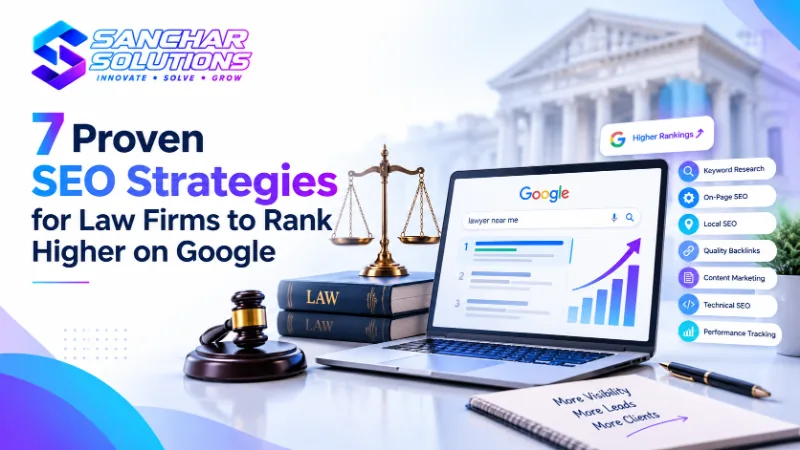
For most people looking for legal help, the journey starts with a Google search. They may search for a “lawyer near me,” a specific legal service, or an answer to a legal question before they ever contact a law firm. This makes SEO for law firms an important part of building online visibility and generating qualified leads.
However, ranking a law firm website on Google requires more than adding the word “lawyer” repeatedly to a page. Search engines increasingly focus on useful, relevant content and overall website quality. Google also actively discourages practices such as keyword stuffing and creating large amounts of low-value content purely to manipulate rankings.
For law firms that want sustainable growth, SEO should therefore combine technical optimization, useful content, local search visibility, authority building, and a strong user experience.
At Sanchar Solutions, we help businesses strengthen their digital presence through SEO, website development, digital marketing, and IT solutions. In this guide, we explore seven practical SEO strategies for law firms that can improve search visibility and help turn online searches into potential client inquiries.
Keyword research is the foundation of an effective law firm SEO strategy.
Instead of targeting only broad keywords such as “lawyer” or “law firm,” identify the specific terms potential clients use when looking for your services.
For example, a family law practice could target:
A corporate law firm might target:
The advantage of specific, long-tail keywords is that they often communicate stronger search intent. Someone searching for “property dispute lawyer in Noida” has a much more specific requirement than someone simply searching for “lawyer.”
Create a keyword map that connects each important search term with the most relevant page on your website. Your service pages should target commercial keywords, while blog posts can address informational searches and common legal questions.
The objective is not to use a keyword as many times as possible. Google identifies keyword stuffing as a spam practice, particularly when repeated terms make content unnatural or provide little value to readers.
One of the strongest ways to build long-term organic visibility is to publish useful content that directly answers the questions prospective clients are asking.
A law firm's blog can cover topics such as:
This type of legal content marketing can help your website target a wider range of relevant searches while demonstrating expertise to potential clients.
However, avoid publishing dozens of nearly identical articles simply because they contain different keywords. Google describes scaled content abuse as producing large quantities of content primarily to manipulate search rankings rather than to help users.
Every article should have a clear purpose, provide genuinely useful information, and be written for the people who may actually need your legal services.
For sensitive legal topics, accuracy is particularly important. Content should clearly distinguish general educational information from personalized legal advice and should be reviewed by appropriately qualified professionals where necessary.
A professional website is the foundation of your online marketing strategy. Even excellent content can struggle to perform when important pages are poorly structured or difficult for users and search engines to understand.
Effective law firm website SEO should include optimization of:
Page titles: Create concise titles that explain the topic and include the primary search phrase naturally.
Meta descriptions: Write compelling descriptions that accurately communicate what visitors will find on the page.
Headings: Use a logical H1, H2, and H3 structure to organize information.
URLs: Keep URLs simple, descriptive, and relevant to the page.
Internal links: Connect related service pages and blog posts to help visitors discover useful information.
Images: Use descriptive file names and appropriate alternative text where relevant.
Calls to action: Make it easy for prospective clients to contact your firm or request an appropriate consultation.
For example, instead of creating one generic page called “Services,” a law firm can create dedicated pages for family law, property law, corporate law, criminal law, or other practice areas it genuinely offers.
This gives users clearer information and creates more opportunities to rank for specific searches.
For many lawyers and law firms, local search is essential because clients often want legal professionals serving their city or region.
This is where local SEO for law firms becomes especially valuable.
An important starting point is your Google Business Profile. Google states that local search results are primarily influenced by relevance, distance, and prominence. Providing complete and accurate business information can help Google understand how your business matches relevant local searches.
A law firm should ensure that its business information is accurate and consistent across relevant platforms. Depending on eligibility and applicable rules, this can include:
Reviews can also contribute to local prominence, but firms should focus on obtaining authentic feedback rather than attempting to manipulate reviews or ratings. Google notes that reviews and other online signals can contribute to prominence in local search.
Location-specific website pages can complement your local strategy when they offer genuinely useful information rather than simply repeating city names.
Backlinks remain an important part of SEO because they can help search engines discover and understand the authority of a website.
For a law firm, the focus should be on earning relevant and credible backlinks, not collecting as many links as possible.
Potential opportunities may include:
For example, an original legal guide that answers a common business question may naturally attract references from relevant websites.
Avoid purchasing low-quality links or participating in link schemes designed primarily to manipulate search rankings. Google identifies link spam as a prohibited practice under its search spam policies.
A smaller number of genuinely relevant links can be more valuable than a large collection of unrelated links.
SEO is not only about content. Your website also needs a strong technical foundation.
A potential client may leave a site if pages are slow, navigation is confusing, forms do not work, or the website is difficult to use on a smartphone.
A technical SEO audit for a law firm should examine areas such as:
Mobile optimization is particularly important because many people searching for local services use smartphones.
Your website should make essential information easy to find: what services you provide, where you operate, how to contact you, and what the next step should be.
Sanchar Solutions can help businesses combine SEO services, web development, website maintenance, and IT solutions to create a technically stronger digital presence.
SEO is not a one-time activity. Search behavior, competitors, website content, and business priorities can all change over time.
That is why law firms should monitor performance regularly rather than judging SEO only by whether one keyword moves up or down.
Useful metrics include:
The most important goal is not simply achieving higher rankings. The goal is attracting relevant potential clients and creating a website experience that encourages appropriate inquiries.
For example, ranking highly for an irrelevant keyword may generate traffic without producing business. A lower-volume keyword that attracts people specifically searching for your legal service can be much more commercially meaningful.
This is why SEO strategy should connect search data with actual business results.
Competition in the legal sector can be strong, especially in major cities and highly competitive practice areas. Traditional referrals and networking can remain valuable, but digital search provides another way for potential clients to discover a firm.
A well-optimized website can help a law firm become visible at multiple stages of the customer journey.
A person may first discover a firm through an informational article, then visit a practice-area page, check the firm's location and reviews, and eventually submit a consultation request.
That entire journey can be supported by a properly planned digital marketing strategy for law firms.
SEO also has a compounding advantage: useful pages can continue attracting search traffic over time, provided they remain relevant, accurate, technically accessible, and competitive.
Successful SEO requires more than publishing blogs and adding keywords. It requires a complete strategy that connects technical SEO, content, local search, website development, analytics, and lead generation.
Sanchar Solutions helps businesses develop stronger digital foundations through SEO, web development, digital marketing, and IT services.
For law firms, this can include:
Our approach focuses on building a useful, professional online presence that supports long-term business growth rather than relying on short-term SEO shortcuts.
SEO for law firms is the process of improving a legal website and its online presence so that it can appear more prominently for relevant searches on Google and other search engines. It can involve keyword research, content creation, technical SEO, local SEO, internal linking, website optimization, and authority building.
SEO does not have a guaranteed timeline. Results can vary based on competition, website history, technical condition, content quality, location, authority, and the search terms being targeted. SEO should generally be treated as a long-term marketing investment rather than an instant lead-generation method.
Law firms should target keywords closely connected to their actual practice areas, locations, and client needs. These may include service-based, location-based, and informational long-tail keywords. A proper keyword strategy should consider relevance and search intent rather than focusing only on search volume.
Yes. Local SEO can be particularly useful for firms that serve clients in specific cities or geographic areas. Google says local results are primarily based on relevance, distance, and prominence, making accurate business information and a strong local presence important elements of a local SEO strategy.
Yes. Helpful, original blog content can give a law firm additional opportunities to address relevant searches and answer potential clients' questions. However, content should be created for users rather than produced in large quantities solely to manipulate rankings.
A law firm may consider working with an experienced SEO agency when it does not have the internal expertise or resources to manage technical SEO, content strategy, local SEO, analytics, and ongoing optimization. The right approach depends on the firm's goals, resources, target market, and competitive environment.
Our team of developers, SEO specialists and marketers has delivered 350+ projects for clients in 10+ countries. We write about what we practise every day.
Rank higher, get more traffic and grow your business organically with data-driven SEO strategies.
Explore SEO ServicesERP software and accounting software serve different purposes for growing businesses. While accounting software focuses on financial…
Read articleSEO vs. Google Ads in 2026: Discover the key differences, costs, benefits, and results of both strategies. Learn which digital marketing…
Read articleidentifying your priorities and discussing the requirements of your project. Before selecting any service provider, review its service…
Read articleShare your requirements and get a free consultation, timeline and fixed-price quote within 24 hours.