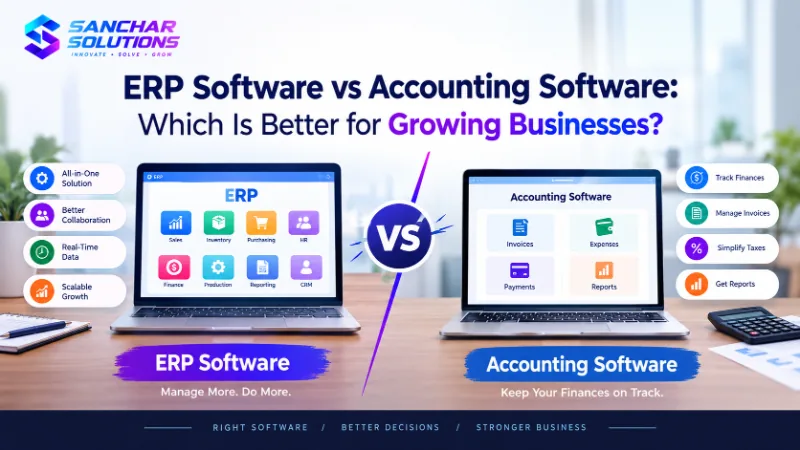
ERP Software vs Accounting Software: Which Is Better for Growing Businesses?
ERP software and accounting software serve different purposes for growing businesses. While accounting software focuses on financial…
Read article
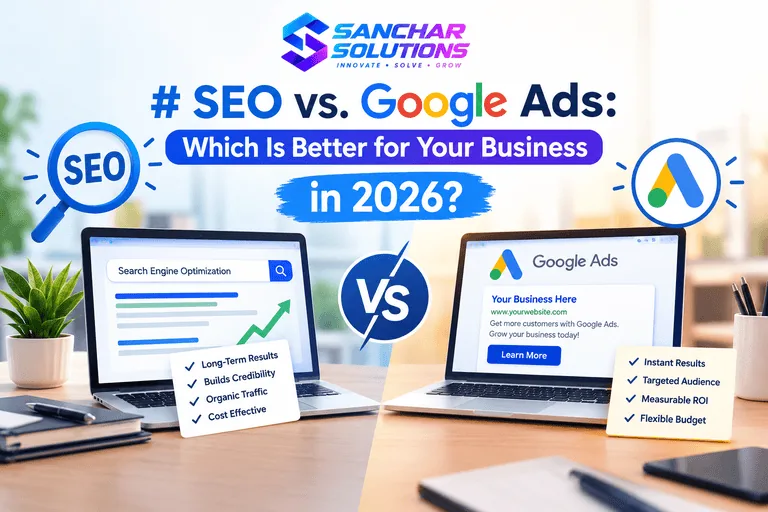
Every business wants to attract more customers, generate quality leads, and increase sales online. But when it comes to digital marketing, many business owners face a common question: Should you invest in SEO or Google Ads?
Both strategies can help your business reach potential customers through Google, but they work in different ways. SEO focuses on improving your website's visibility in organic search results, while Google Ads allows you to pay for advertising placements and reach potential customers through targeted campaigns.
In 2026, choosing the right strategy depends on your business goals, marketing budget, competition, and how quickly you want to see results. Some businesses benefit more from SEO, while others need the immediate visibility that paid advertising can offer. Many businesses can benefit from using both together.
In this guide, we will explain the difference between SEO and Google Ads, compare their benefits and costs, and help you decide which approach is right for your business.
Search Engine Optimization (SEO) is the process of improving a website so that it can appear more prominently in organic, unpaid search results. The goal is to help search engines understand your website and make your content easier for potential customers to discover.
For example, if someone searches for “digital marketing agency in Noida,” a well-optimized website offering relevant services may appear in the organic search results.
SEO involves several activities, including:
Keyword research: Identifying the search terms your potential customers use.
On-page SEO: Improving page titles, meta descriptions, headings, content, and internal links.
Technical SEO: Helping search engines crawl and index your website while improving its technical performance.
Content marketing: Publishing useful blogs, service pages, and guides that answer customer questions.
Off-page SEO: Earning relevant backlinks and building your website's authority.
Local SEO: Improving visibility for location-based searches and relevant local business queries.
SEO is a long-term strategy. Results depend on factors such as competition, website quality, content relevance, and the work being implemented. There is no guaranteed ranking position or fixed timeline.
According to Google's SEO Starter Guide, creating helpful content and making a website easier for search engines to understand are important parts of SEO.
Google Ads is an online advertising platform that allows businesses to promote their products and services across eligible Google advertising placements.
With Google Search Ads, your business can appear in sponsored search results when people search for relevant keywords. These listings are identified as advertisements and are separate from organic search results.
For example, a website development company can create a Google Ads campaign targeting searches such as “hire a website developer” or “website development services in Noida.”
Google Ads campaigns can include:
Search Ads: Text advertisements shown for relevant search queries.
Display Ads: Visual advertisements shown across eligible websites and placements.
Shopping Ads: Product advertisements for eligible e-commerce businesses.
YouTube Ads: Video advertisements that help businesses reach relevant audiences.
Remarketing campaigns: Campaigns designed to reconnect with eligible audiences who previously interacted with a business.
Google Ads offers control over campaign budgets, locations, keywords, ad messages, and targeting options. Depending on the campaign type and bidding strategy, advertisers may pay for clicks, impressions, or other defined actions.
Unlike SEO, Google Ads can generate visibility soon after a campaign is approved and begins running. However, results depend on the campaign setup, competition, budget, landing page, and offer.
SEO and Google Ads can both support business growth, but their costs, timelines, and working methods are different.
| Comparison | SEO | Google Ads |
|---|---|---|
| Traffic type | Organic search traffic | Paid advertising traffic |
| Initial visibility | Usually takes time | Can begin after campaign launch and approval |
| Direct payment per click | No charge for organic clicks | Often uses a pay-per-click model |
| Long-term potential | Can build lasting organic visibility | Ads stop serving when campaigns stop or become ineligible |
| Budget control | Investment in content, expertise, and website improvements | Advertising budget and campaign management costs |
| Best suited for | Sustainable organic visibility | Time-sensitive campaigns and faster traffic acquisition |
| Main activities | Content, technical optimization, keyword research, link earning | Campaign setup, bidding, ad copy, targeting, conversion tracking |
| Ranking guarantee | No guaranteed rankings | No guaranteed ad placement or conversions |
Important: SEO is not free to implement. Even though businesses do not pay Google for organic clicks, SEO can require investment in professional services, content creation, technical improvements, and ongoing maintenance.
Google Ads also does not directly improve a website's organic rankings. Paid and organic search are separate channels.
SEO can be a valuable investment for businesses that want to build their online presence and attract relevant visitors over time.
SEO helps your website become more discoverable for searches related to your products and services. When your pages provide useful answers and meet searchers' needs, they may earn organic visibility.
For example, a digital marketing agency can publish informative content about local SEO, website optimization, and lead generation. These pages may attract visitors who are researching marketing services.
Organic visibility can continue to generate traffic while pages remain relevant and competitive, although rankings and traffic can change.
Effective SEO focuses on search intent, which means understanding what people actually want when they enter a query.
Someone searching for “what is SEO” may want educational information, while someone searching for “SEO agency for small business” may be comparing service providers.
Creating the right content for each intent helps businesses attract visitors who are more relevant to their offerings.
Many customers research a business before contacting it. A useful website with clear service information, helpful articles, transparent contact details, and genuine customer reviews can support trust.
SEO can help potential customers discover these resources through relevant searches. However, rankings alone do not guarantee credibility or sales.
SEO and content marketing work well together. Blogs, guides, FAQs, and service pages can answer common questions while introducing potential customers to your business.
Over time, a well-planned content library can support different stages of the customer journey, from initial research to comparing providers.
SEO can become a valuable long-term channel when a website earns consistent relevant traffic and converts visitors into enquiries or sales.
The results are not automatic. Businesses need to monitor performance, update important pages, maintain website quality, and respond to changes in customer needs and search behaviour.
Google Ads can help businesses reach potential customers when they need more immediate visibility or want to promote a specific offer.
Once a campaign is approved and running, ads may begin appearing for relevant searches without waiting for organic rankings to improve.
This can be useful for a new business, a seasonal promotion, or a company launching a new service.
Location targeting can help businesses focus advertising on selected geographic areas.
For example, a Noida-based website development company may want to reach businesses in Noida, Greater Noida, or other serviceable locations rather than advertising everywhere.
The right targeting depends on where the business can serve customers profitably.
Businesses can set campaign budgets and adjust spending based on their goals and performance.
However, setting a budget does not guarantee a particular number of clicks, enquiries, or sales. Results depend on keyword competition, campaign settings, customer demand, and other factors.
Google Ads can help businesses test which search terms, messages, and offers attract potential customers.
For example, a company could compare different service-focused ads to understand which messages generate more qualified enquiries. These insights may also help inform website content and future marketing decisions.
With appropriate conversion tracking, businesses can measure actions such as form submissions, phone calls, purchases, and other valuable interactions.
This helps marketers evaluate campaign performance and make informed adjustments instead of focusing only on clicks or impressions.
The cost-effectiveness of SEO and Google Ads depends on your business, competition, conversion rate, average customer value, and time frame.
With SEO, the investment may go toward content, technical work, website improvements, and professional support. You do not pay Google for each organic click, but achieving and maintaining visibility requires ongoing effort.
With Google Ads, the business pays for advertising activity according to its campaign model. Highly competitive keywords can be expensive, and clicks do not always turn into customers.
Consider a simple example.
A website development company invests in SEO to improve its service pages and publish helpful articles. It also runs Google Ads to attract people actively searching for website development services.
Google Ads may help generate enquiries sooner, while SEO works toward stronger organic visibility over time. The company can compare the cost of qualified leads from each channel to decide how to allocate its budget.
Rather than asking which channel is always cheaper, businesses should ask:
How much does it cost to acquire a qualified lead?
How many enquiries turn into paying customers?
What is the average revenue or profit per customer?
How long does it take to recover the marketing investment?
Are the results consistent enough to support business growth?
These measurements provide a more useful comparison than traffic numbers alone.
For small businesses, the right strategy depends on immediate needs and available resources.
Choose SEO as a priority if:
You want to build organic visibility over the long term.
Your customers regularly search for your services online.
You can invest in useful content and website improvements.
You want to develop a stronger website presence beyond paid campaigns.
Consider Google Ads as a priority if:
You need to promote a service or offer quickly.
You have a defined advertising budget.
You know which customers and locations you want to target.
Your website is ready to convert relevant visitors into enquiries or sales.
You can measure results and adjust campaigns based on performance.
A business should not run paid campaigns without considering its landing page, contact process, pricing, and ability to handle enquiries. Paying for traffic is less useful when visitors cannot easily understand the offer or take the next step.
SEO and Google Ads do not have to compete for the same budget. When planned carefully, they can serve different purposes within one digital marketing strategy.
Here is how a combined approach can work:
Step 1: Use Google Ads to test demand.
Run focused campaigns for relevant services and measure which keywords and offers generate qualified enquiries.
Step 2: Improve important website pages.
Create clear landing pages that explain your services, benefits, process, and contact options.
Step 3: Build long-term organic visibility.
Use keyword research and customer questions to create helpful content and improve relevant service pages.
Step 4: Track conversions from both channels.
Measure leads and sales instead of relying only on clicks, impressions, or rankings.
Step 5: Review and adjust your budget.
Invest more in the channels and campaigns that produce suitable business outcomes, while continuing to improve your website.
For example, a small e-commerce business could use Google Ads to promote selected products while investing in SEO for product pages, category pages, and buying guides. The advertising campaign can support immediate promotion, while SEO works toward organic product discovery.
The best balance will vary by business, and neither channel guarantees a particular return.
Businesses can waste time or money when they approach SEO and Google Ads without a clear plan.
Avoid these common mistakes:
Expecting instant SEO rankings: SEO takes time, and ranking improvements are never guaranteed.
Running ads without conversion tracking: Without useful measurement, it becomes harder to evaluate campaign performance.
Targeting irrelevant keywords: Traffic is less valuable when visitors are not interested in your services.
Sending every ad visitor to the homepage: A relevant landing page often provides a clearer next step.
Ignoring website performance: Slow pages, confusing navigation, and broken forms can discourage potential customers.
Measuring success only by traffic: Qualified leads, sales, revenue, and profitability matter more than visits alone.
Assuming paid ads improve organic rankings: Google Ads does not directly increase organic search positions.
A clear strategy, useful website content, and regular performance reviews can help businesses make better marketing decisions.
Choosing between SEO and Google Ads is only one part of building an effective online presence. Businesses also need a well-structured website, clear service pages, relevant content, and a practical plan for attracting and converting potential customers.
Sanchar Solutions can be positioned as a partner for businesses exploring digital growth through services such as SEO, website development, and digital marketing, depending on the services available on its website.
A suitable strategy begins with understanding your business goals, target audience, competition, budget, and current website performance. From there, businesses can identify whether organic search, paid advertising, or a combination of both is the most appropriate approach.
The goal should not simply be to bring more people to your website. It should be to attract the right audience and make it easier for potential customers to take meaningful action.
Neither is universally better. SEO is useful for building long-term organic visibility, while Google Ads can provide faster paid visibility. The right choice depends on your goals, budget, competition, and timeline.
No. Google Ads does not directly improve organic search rankings. Paid advertising and organic search use separate systems.
SEO timelines vary according to website condition, competition, content quality, and the changes being implemented. Some improvements may be visible within weeks, while others can take several months or longer. There is no guaranteed timeline.
Yes. A small business can use Google Ads for targeted campaigns while developing SEO for long-term organic visibility. The budget split should depend on business priorities and measured results.
Both can generate leads. Google Ads may help businesses reach relevant searchers quickly, while SEO can attract visitors through organic results over time. Lead quality, website experience, and conversion tracking are important for both.
Not necessarily. A business can run Google Ads before its SEO strategy has matured, provided the website and landing pages are ready. At the same time, investing in SEO can help develop a stronger long-term marketing foundation.
SEO vs. Google Ads is not simply a choice between free traffic and paid traffic. It is a decision about how your business wants to attract customers, manage its marketing budget, and grow online.
SEO can help build sustainable organic visibility, useful website content, and long-term opportunities to attract relevant visitors. Google Ads can provide faster paid visibility, targeted promotion, and measurable campaign data.
For many businesses in 2026, a balanced strategy can be effective: use Google Ads where immediate visibility is important, while developing SEO to support long-term growth.
Before choosing either approach, define your goals, understand your audience, improve your website, and measure the results that matter to your business. With a clear plan, you can make more informed digital marketing decisions and build a stronger online presence.
Our team of developers, SEO specialists and marketers has delivered 350+ projects for clients in 10+ countries. We write about what we practise every day.
Rank higher, get more traffic and grow your business organically with data-driven SEO strategies.
Explore SEO ServicesERP software and accounting software serve different purposes for growing businesses. While accounting software focuses on financial…
Read articleidentifying your priorities and discussing the requirements of your project. Before selecting any service provider, review its service…
Read articleappear in local Google searches and Google Maps results. For example, imagine someone in Noida searches: SEO agency in Noida Software…
Read articleShare your requirements and get a free consultation, timeline and fixed-price quote within 24 hours.