AI Web Design Trends 2026 A Simple Guide for Businesses Hiring in Noida
Learn how AI is changing web design in 2026 and what businesses in Noida should know before choosing a modern, AI-powered website.
Read article
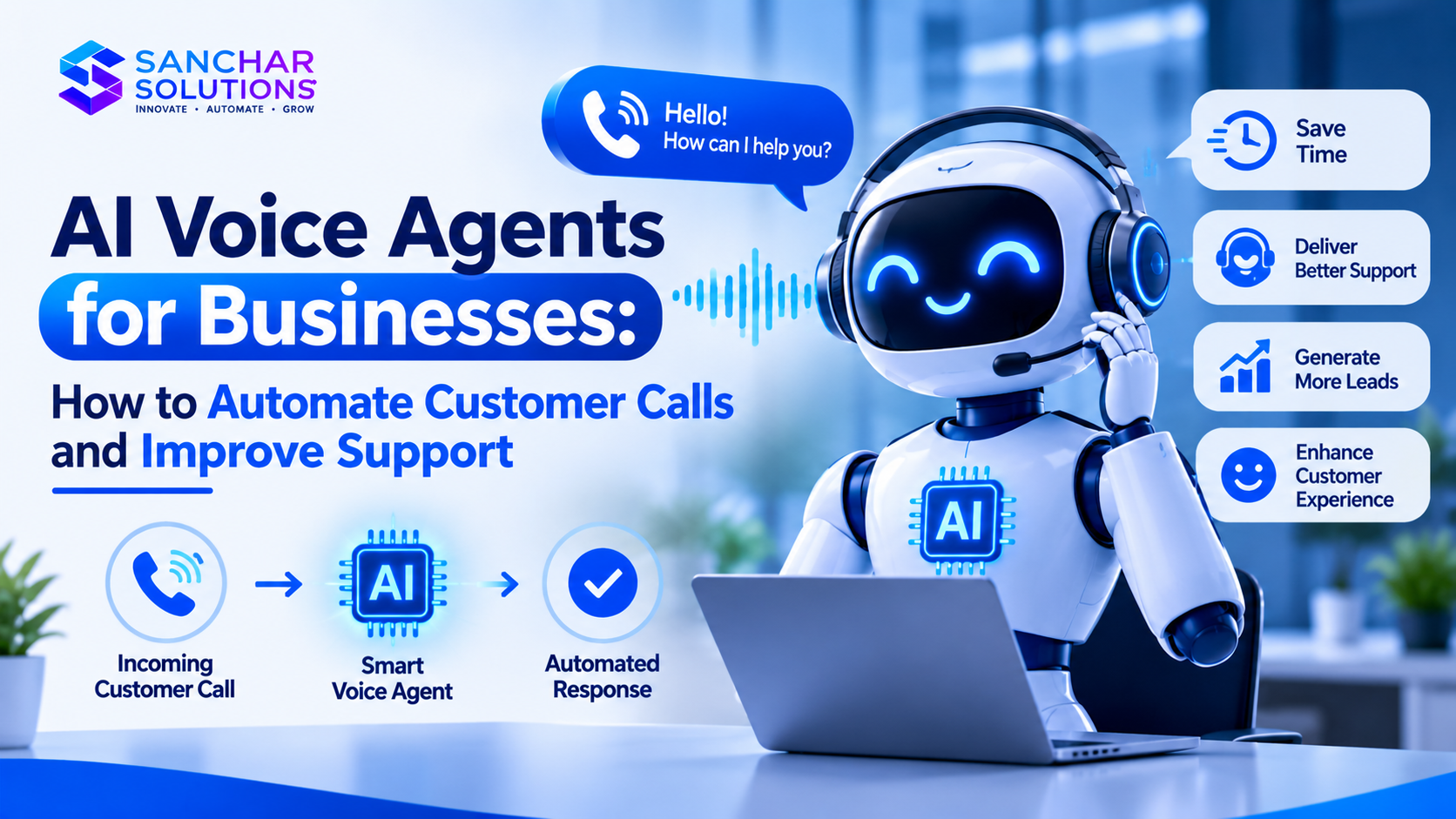
Customer communication plays an important role in business growth. Whether a company receives product enquiries, appointment requests, service questions or sales calls, customers expect quick and helpful responses. However, managing every incoming call manually can become difficult as a business grows.
Missed calls, long waiting times, repetitive questions and limited support availability can affect customer satisfaction and lead generation. This is where AI voice agents can make a difference.
AI voice agents use artificial intelligence to communicate with customers through natural-sounding conversations. They can answer common questions, collect information, qualify leads, schedule appointments and transfer complex enquiries to human representatives.
For businesses looking to improve customer communication, AI voice agents offer an opportunity to automate routine calls while allowing employees to focus on more important tasks.
AI voice agents are AI-powered systems that can understand spoken language and respond to customers through voice conversations. Unlike traditional automated phone systems that depend mainly on fixed menus, AI voice agents can understand different questions and provide relevant responses.
They use technologies such as speech recognition, natural language processing and text-to-speech to communicate with callers.
For example, when a customer calls a service company to ask about pricing, availability or appointment timings, an AI voice agent can understand the request and provide the required information using its configured business knowledge.
Depending on the business requirements, these systems can also connect with customer relationship management (CRM) platforms, appointment tools and other business applications.
Businesses exploring conversational AI and automation solutions can use these technologies to improve customer interactions across different communication channels.
AI voice agents combine multiple technologies to manage a conversation from beginning to end. Although the technical setup may vary, the general process involves the following steps.
When a customer speaks, the system uses automatic speech recognition (ASR) to convert spoken words into text. This allows the AI to identify what the caller is asking.
Natural language processing (NLP) helps the system understand the meaning and intent behind the customer's words. It can identify whether someone wants product information, technical assistance, an appointment or help with an existing order.
After understanding the request, the AI generates an appropriate response using its configured information, business rules and connected data sources.
Text-to-speech technology converts the generated response into spoken language. The customer hears the answer through the phone call.
Depending on its integrations and permissions, the AI agent may collect customer details, create a support request, schedule an appointment or transfer the call to a human representative.
This process helps businesses manage common customer enquiries without requiring an employee to answer every routine call.
AI voice agents can support businesses in several ways. Their value depends on how well they are configured and how effectively they fit into existing business operations.
Customers often become frustrated when they have to wait for someone to answer their calls. AI voice agents can respond to incoming calls automatically and handle common enquiries without unnecessary delays.
This can improve the overall communication experience, particularly for businesses that receive frequent customer calls.
Traditional customer support teams generally operate during fixed working hours. AI voice agents can provide automated assistance outside those hours, depending on the system configuration.
Customers may be able to check basic information, leave their details, request a callback or complete other supported tasks even when the office is closed.
Employees often spend considerable time answering the same questions about business hours, pricing, appointments, services and order updates.
AI voice agents can handle many of these repetitive conversations. This allows employees to focus on complex customer issues, relationship building and important business activities.
Not every incoming call represents a suitable sales opportunity. AI voice agents can ask relevant questions to understand a caller's requirements, budget, location or service needs.
The collected information can help sales teams identify promising enquiries and follow up with better context.
Businesses receiving a high volume of calls may struggle to manage every enquiry efficiently. AI voice agents can help organise incoming requests, collect relevant details and route calls according to predefined business rules.
A properly configured AI voice agent follows approved business information and conversation guidelines. This can help maintain consistent responses to common questions.
However, businesses should regularly review the system to ensure that the information remains accurate and up to date.
AI voice agents can be useful across different industries. Their applications depend on the nature of the business and the type of customer interactions involved.
Healthcare providers can use AI voice agents to manage appointment requests, share clinic timings, send reminders and answer general administrative questions.
Sensitive medical questions should be directed to qualified healthcare professionals rather than handled through unsupported automated responses.
Real estate companies can use voice agents to respond to property enquiries, collect buyer requirements, schedule property visits and forward qualified leads to sales representatives.
Online stores can automate common questions related to order status, delivery information, return policies and product availability when connected to suitable business systems.
Financial service providers may use voice automation for general information, service requests and customer routing. Strong identity verification, privacy safeguards and regulatory compliance are essential in this sector.
Educational institutions can use AI voice agents to respond to admission enquiries, explain course information, share application deadlines and schedule counselling calls.
Hotels, travel agencies and service providers can automate booking enquiries, reservation information, availability checks and frequently asked questions.
Traditional Interactive Voice Response (IVR) systems help businesses manage incoming calls through recorded messages and predefined menus. AI voice agents offer a more conversational approach.
| Feature | Traditional IVR | AI Voice Agents |
|---|---|---|
| Interaction | Fixed menu options | Natural voice conversations |
| Customer input | Mainly keypad selection | Spoken language |
| Understanding | Predefined commands | AI-based intent understanding |
| Flexibility | Limited to configured menus | Can handle varied supported questions |
| Personalisation | Usually limited | Possible with relevant customer data |
| Integration | Depends on the system | Can connect with CRM and business tools |
| Human support | Menu-based routing | Context-based transfer when configured |
Traditional IVR can still be suitable for businesses with simple call-routing requirements. AI voice agents may be more useful when customer conversations involve varied questions and multiple steps.
Businesses can also combine both technologies as part of their broader voice and telephony solutions.
Choosing an AI voice agent requires more than checking whether it can answer calls. Businesses should consider the following capabilities before implementation.
Natural voice conversations: The system should communicate clearly and understand common variations in customer language.
Multilingual support: Businesses serving customers in different regions may need support for multiple languages.
CRM integration: Connecting the agent with CRM software can help record enquiries and maintain customer information.
Call transfer: The system should be able to transfer complex or sensitive conversations to a human representative.
Call recording and analytics: Where legally permitted, call records and analytics can help businesses evaluate performance.
Custom business knowledge: The agent should use accurate information about the company's services, policies and processes.
Data security: Customer information should be protected through appropriate access controls, retention policies and security measures.
The right combination of features depends on the business's call volume, customer expectations, operational needs and budget.
A successful implementation starts with understanding business requirements rather than automating every call immediately.
Review the types of calls your business receives. Identify common questions, appointment requests, lead enquiries and other repetitive tasks that could be automated.
Decide exactly what the AI voice agent should handle. For example, it may answer basic questions, collect lead information or schedule appointments.
Also define what it should not handle. Complex complaints, sensitive information and exceptional requests may require human assistance.
Provide the agent with verified details about your products, services, pricing, working hours and policies. Outdated or incomplete information can lead to incorrect responses.
Depending on the requirements, integrate the voice agent with CRM platforms, calendars, customer databases, helpdesk systems or telephony infrastructure.
Test the system with different accents, speaking styles, background noise and unexpected questions. Check whether it understands callers correctly and transfers conversations when necessary.
After launch, review call outcomes, customer feedback, transfer rates and unresolved enquiries. Use these insights to improve conversation flows and system accuracy.
Although AI voice agents can improve customer communication, they are not suitable for every situation.
Background noise, unclear speech, strong accents and complicated requests may affect how accurately the system understands a caller. Poorly configured agents may also provide incomplete or incorrect information.
Privacy and compliance are equally important. Businesses should inform callers about recording or automated interactions where required by applicable laws. Customer data must be handled responsibly, and sensitive conversations should have appropriate human support.
The best approach is to use AI voice agents for clearly defined tasks while keeping human representatives available for situations that require judgement, empathy or specialised knowledge.
Every business has different communication requirements. A company receiving hundreds of sales enquiries may need a different solution from a healthcare provider managing appointment requests or a service business handling customer support calls.
Sanchar Solutions helps businesses explore technology solutions based on their operational requirements. Its AI capabilities include conversational automation and intelligent customer interaction systems.
Through solutions such as Aura AI, businesses can explore AI-powered voice and customer interaction experiences designed around their communication needs.
The implementation approach should begin with understanding the existing workflow, identifying suitable automation opportunities and defining how the AI system will work alongside human teams.
AI voice agents are changing how businesses manage customer calls and routine communication. They can help answer common questions, qualify leads, manage appointment requests and provide support beyond traditional working hours.
However, successful automation requires proper planning, accurate business information, suitable integrations and regular monitoring. Businesses should begin with repetitive, well-defined tasks and gradually expand automation based on actual performance.
When implemented thoughtfully, AI voice agents can reduce manual workload, improve response times and create a more organised customer communication process.
An AI voice agent is an artificial intelligence-powered system that communicates with people through spoken conversations. It can understand customer questions and provide relevant responses using speech recognition and language processing technologies.
They help businesses automate routine calls, answer common questions, collect customer details, qualify leads and manage appointment requests. This can reduce repetitive work and improve response times.
Yes. They can handle supported customer support tasks such as answering frequently asked questions, sharing service information and creating requests. Complex issues can be transferred to human representatives.
AI voice agents can provide automated assistance around the clock when the required infrastructure and integrations are available. However, human support availability may still depend on the business's working hours.
They serve different purposes. Traditional IVR systems are useful for structured call routing, while AI voice agents can understand natural speech and manage more flexible conversations. The right choice depends on business requirements.
Yes. They can ask predefined questions, collect contact information and identify whether an enquiry matches specific business criteria. Qualified leads can then be forwarded to the sales team.
Many AI voice solutions support multiple languages. The available languages, voice quality and accuracy depend on the selected technology and its configuration.
Yes. AI voice agents can integrate with compatible CRM platforms to record customer details, update lead information and support follow-up workflows. Integration capabilities depend on the systems being used.
Yes. Small businesses can use them to manage repetitive enquiries, appointment requests and basic customer support. The solution should be selected according to call volume, budget and operational needs.
Start by identifying repetitive calls, defining the tasks that can be automated and preparing accurate business information. Then select a suitable solution, test it with real scenarios and monitor its performance after launch.
Our team of developers, SEO specialists and marketers has delivered 350+ projects for clients in 10+ countries. We write about what we practise every day.
An AI voice agent that answers and makes phone calls in Hindi, English and regional languages, 24/7.
Explore AI Voice AgentLearn how AI is changing web design in 2026 and what businesses in Noida should know before choosing a modern, AI-powered website.
Read articleIntroduction Businesses today are looking for practical ways to save time, improve productivity, reduce repetitive work, and deliver…
Read articleShare your requirements and get a free consultation, timeline and fixed-price quote within 24 hours.