AI Web Design Trends 2026 A Simple Guide for Businesses Hiring in Noida
Learn how AI is changing web design in 2026 and what businesses in Noida should know before choosing a modern, AI-powered website.
Read article
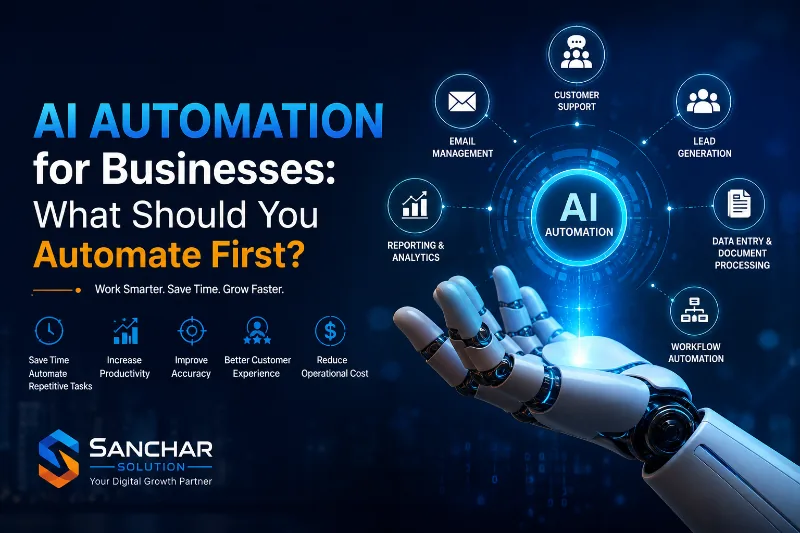
Businesses today are looking for practical ways to save time, improve productivity, reduce repetitive work, and deliver better customer experiences. AI automation for businesses is becoming an important part of this transformation because it allows companies to automate routine processes while giving employees more time to focus on important business decisions.
However, one common mistake is trying to automate everything at once.
The better approach is to identify repetitive, time-consuming, and measurable processes first. Once the right processes are identified, businesses can gradually introduce AI automation, workflow automation, conversational AI, and system integrations.
For businesses exploring these opportunities, sancharsolution can be approached as a technology partner across AI, software development, digital marketing, communication, cloud, and IT services.
AI automation combines artificial intelligence with automated workflows to complete tasks that traditionally require manual human involvement.
Traditional automation generally follows predefined rules. AI-powered automation can go further by working with language, documents, customer conversations, patterns, and business data.
For example, a business could use AI to:
The objective isn't necessarily to replace employees. Instead, business process automation can reduce repetitive workloads and allow teams to concentrate on higher-value activities.
Not every business process is suitable for AI automation. The best starting point is usually a process that is repetitive, predictable, time-consuming, and easy to measure.
Here are some of the areas businesses should consider first.
Customer support is one of the strongest starting points for AI automation solutions.
Businesses receive many repetitive questions about products, services, pricing, availability, order status, processes, and basic troubleshooting.
A conversational AI system can provide instant responses to common questions and route more complex issues to human representatives.
For example:
Customer question → AI understands request → Provides relevant information → Escalates complex issue to employee
This approach can help businesses provide faster responses without requiring employees to manually answer every basic question.
Generating leads is only part of the sales process. Teams also need to determine which leads are worth following up with.
AI-powered lead automation can collect information, understand customer requirements, categorize enquiries, and prioritize potential prospects.
A simple workflow could look like:
Website enquiry → AI qualification → Lead categorization → CRM entry → Sales team notification
This can reduce manual data entry and help sales teams spend more time with qualified prospects.
Businesses looking for AI lead generation and automated customer journeys can combine AI with CRM systems, websites, messaging platforms, and marketing campaigns.
Employees can spend a significant amount of time reading, sorting, responding to, and forwarding routine communications.
AI can assist with:
For larger organizations, these workflows can also connect with business messaging, WhatsApp Business, email communication, voice, and contact center systems.
This creates a more connected communication environment instead of managing every channel separately.
Manual data entry is another strong candidate for automation.
Businesses often move information between websites, CRM platforms, spreadsheets, accounting systems, support tools, and internal applications.
With AI integration and APIs, systems can exchange information automatically.
For example:
Website form → Data validation → CRM → Sales notification → Follow-up workflow
This reduces repetitive work and can also help minimize errors caused by manually copying information between systems.
AI automation isn't only for customer-facing activities.
Companies can automate internal workflows such as:
Before implementing automation, businesses should identify where employees repeatedly perform the same steps.
If a task happens hundreds of times every month, it may be worth investigating for automation.
A simple way to prioritize automation is to score each business process against five factors:
| Factor | Question |
|---|---|
| Frequency | How often does the task happen? |
| Time | How much employee time does it consume? |
| Repetition | Are the same steps repeated? |
| Complexity | Can the process be clearly defined? |
| Impact | What happens if the process becomes faster? |
A process that scores highly across these areas is usually a stronger automation candidate.
For example, manually answering 500 similar customer questions every month is generally a better first automation project than automating a complex process that only happens twice a year.
AI automation becomes more useful when it works with the systems a company already uses.
A business may need connections between:
This is where API & integration services become important.
Instead of creating another isolated tool, businesses can build workflows that allow their existing systems to communicate.
For organizations requiring specialized functionality, custom software development can also be used to create applications around specific business requirements.
AI automation can also support a company's digital marketing activities.
For example, marketing teams can automate parts of:
However, automation should support a marketing strategy rather than replace it.
SEO, performance marketing, social media marketing, content marketing, branding, and lead generation still require strategic decisions, creative thinking, and an understanding of the target audience.
A technology partner such as sancharsolution can therefore combine AI and automation with broader digital marketing capabilities.
E-commerce companies have many opportunities for automation.
Common examples include:
AI can help connect these activities into a more efficient customer journey.
For businesses with unique requirements, e-commerce development, API integration, and custom software can be combined with AI automation to create more specialized workflows.
AI automation doesn't have to live only on a website.
Businesses can integrate AI into:
For example, a mobile application could include an AI assistant that helps customers find information, submit requests, or receive support.
Similarly, custom business software can incorporate AI features directly into existing workflows.
This is why AI projects often work best when they are considered part of a company's broader digital transformation strategy.
Automation also needs a reliable technical foundation.
Businesses may require:
AI applications can create additional requirements for data processing, integrations, security, and scalability.
Therefore, AI automation should not be treated as an isolated technology project. It should fit into the company's wider IT and cloud strategy.
Automation isn't automatically beneficial just because a task can technically be automated.
Businesses should be cautious about automating:
A good rule is simple:
Automate repetitive work, not responsibility.
Human employees should remain involved where judgment, accountability, creativity, or sensitive decision-making is important.
Businesses can start with a simple five-step approach.
List the activities employees perform repeatedly every week or month.
Record time spent, volume, errors, and business impact.
Don't automate ten processes simultaneously. Start with one measurable opportunity.
Connect the automation with relevant websites, CRM platforms, applications, communication channels, or databases.
Track response time, productivity, customer satisfaction, conversion rates, cost savings, or other relevant KPIs.
Once the first workflow performs reliably, businesses can expand automation into other departments.
AI automation is only one part of a modern digital ecosystem.
Businesses may also need web development, e-commerce development, mobile app development, custom software, UI/UX design, API integration, SEO, performance marketing, social media marketing, content marketing, branding, lead generation, business messaging, WhatsApp Business, RCS, voice and telephony, contact center solutions, email communication, enterprise connectivity, AI solutions, conversational AI, cloud solutions, cybersecurity, DevOps, and managed IT services.
This broader combination allows businesses to approach digital transformation from multiple directions instead of implementing disconnected technology projects.
For companies researching AI automation solutions, the most important step is not choosing the most advanced AI tool. It is identifying the business problem that automation can solve effectively.
The best starting point for AI automation for businesses is usually not the most complicated process. It is the repetitive process that consumes significant time and has a clear measurable outcome.
Customer support, lead qualification, email workflows, data entry, internal processes, and business communication can all provide practical opportunities for automation.
As businesses become more digitally connected, AI will increasingly work alongside websites, mobile applications, custom software, cloud infrastructure, marketing platforms, communication systems, and business applications.
The right strategy is to start small, measure results, improve the workflow, and then scale.
For businesses exploring AI automation, AI integration, business process automation, software development, digital marketing, communication technology, and IT solutions, sancharsolution can be positioned as a technology partner capable of supporting multiple parts of the digital transformation journey.
1. What is the best process to automate first in a business?
The best starting point is usually a repetitive, high-volume process with measurable results. Customer support, lead qualification, data entry, email workflows, and internal administrative tasks are common starting points.
2. How can AI automation help small businesses?
AI automation can help small businesses reduce repetitive work, respond to customers faster, organize leads, automate routine communications, and improve operational efficiency without requiring every task to be handled manually.
3. Is AI automation the same as traditional automation?
Not exactly. Traditional automation generally follows predefined rules, while AI automation can work with language, patterns, documents, customer conversations, and other less-structured information.
4. Can AI automation connect with existing business software?
Yes. Through APIs and integrations, AI-powered workflows can often connect websites, CRM systems, applications, e-commerce platforms, communication tools, and other business software.
5. Should businesses automate everything?
No. Businesses should prioritize repetitive and measurable tasks while keeping human involvement in areas requiring judgment, creativity, accountability, empathy, or sensitive decision-making.
Our team of developers, SEO specialists and marketers has delivered 350+ projects for clients in 10+ countries. We write about what we practise every day.
AI voice, avatar and visual interaction for customer support, virtual front desks, advisory and enterprise training.
Explore Aura AILearn how AI is changing web design in 2026 and what businesses in Noida should know before choosing a modern, AI-powered website.
Read articleShare your requirements and get a free consultation, timeline and fixed-price quote within 24 hours.