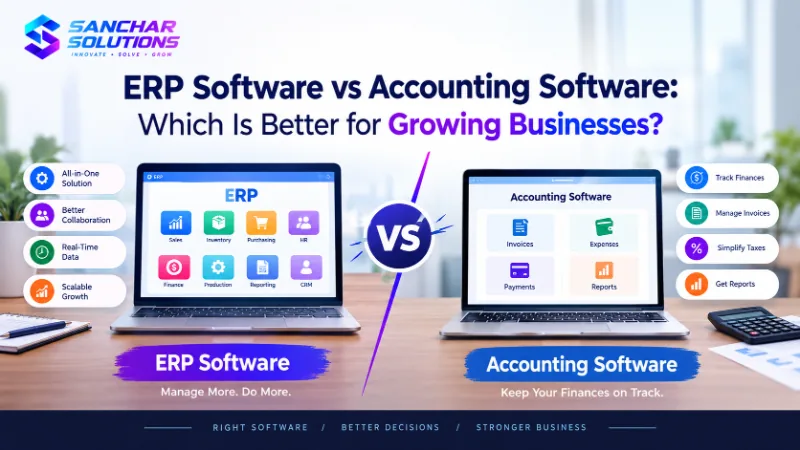
ERP Software vs Accounting Software: Which Is Better for Growing Businesses?
ERP software and accounting software serve different purposes for growing businesses. While accounting software focuses on financial…
Read article
In today's digital-first business environment, having an online presence is no longer optional. Almost every organization needs a reliable digital platform to communicate with customers, showcase services, generate leads, manage information, or deliver digital services.
But an important question often comes before development:
Should your business build a website or a web application?
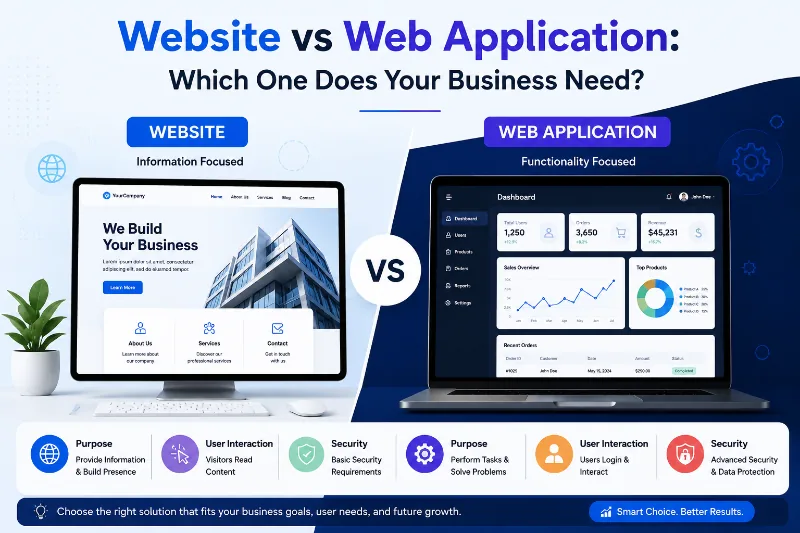
Although the terms are sometimes used interchangeably, websites and web applications serve different purposes. A website is generally designed to provide information and create an online presence, while a web application is an interactive software solution that allows users to perform specific tasks.
Choosing the right solution can have a major impact on your development cost, security, maintenance requirements, scalability, and long-term business growth.
For organizations that require secure data handling, reliable network infrastructure, system integration, and budget-friendly technology maintenance, understanding this difference is particularly important.
A website is a collection of web pages available through the internet. Its primary purpose is usually to provide information to visitors.
Examples include:
A typical business website may contain pages such as Home, About, Services, Portfolio, Case Studies, Blog, Careers, and Contact.
Most visitors browse the content rather than performing complex tasks.
For example, a company website can explain its software development services, display previous projects, publish case studies, and provide a contact form for potential customers.
A web application is an interactive software system that runs through a web browser.
Unlike a traditional website, users typically interact with the application to complete tasks, access personalized information, manage records, or perform business operations.
Examples include:
For example, an organization might have a website that explains its services, while a separate web application allows customers to log in, submit requests, view account information, download documents, and communicate with support teams.
The simplest way to understand the difference is to look at the purpose.
A website primarily provides information.
A web application primarily provides functionality.
For example:
Website:
"Here are our services, company information, portfolio, and contact details."
Web Application:
"Log in, manage your account, submit a request, view your data, generate a report, and complete a transaction."
The two can also work together. A business can have a public-facing website connected to a secure web application or customer portal.
A website is generally the better choice when your main goal is to establish an online presence and provide information.
You may need a website if your organization wants to:
A professional website gives your business a central digital presence where customers can learn about your company, services, expertise, and experience.
A website can use contact forms, landing pages, calls-to-action, chat systems, and other conversion elements to generate potential customers.
A properly optimized website can help your organization appear in search engine results for relevant keywords.
Blog content, service pages, case studies, and landing pages can also support a long-term SEO strategy.
If customers primarily need information before contacting your business, a website may provide everything they need.
Organizations can use websites to publish blogs, guides, announcements, case studies, industry insights, and other content.
For many businesses, a professional website is the most cost-effective starting point.
A web application becomes more appropriate when users need to interact with data or perform specific actions.
Consider a web application if your business requires:
If customers, employees, partners, or administrators need individual accounts and different access permissions, a web application may be more suitable.
Organizations that handle confidential business information may need a secure application with authentication, authorization, role-based access, and controlled data management.
If employees currently perform repetitive tasks manually, a web application can automate workflows.
For example, an internal application could automatically manage:
If users need to log in and view real-time business information, dashboards and web applications can provide a centralized solution.
Businesses often use multiple platforms, including CRM, accounting, payment, communication, cloud, and database systems.
A web application can use APIs to connect these systems and synchronize information.
The answer depends on what your organization actually needs.
A basic business website generally requires less development effort than a complex web application.
A web application can require additional investment because it may involve:
However, choosing the cheapest option is not always the best financial decision.
If your organization needs custom functionality, trying to operate complex business processes through a basic website can create inefficiencies and additional manual work.
The right approach is to determine the business requirements first and then select the appropriate technology.
Security becomes especially important when an organization handles sensitive information.
A simple informational website may not store significant amounts of confidential customer data. However, a web application may process personal information, business records, transactions, employee information, or other sensitive data.
A secure web application may require:
Organizations should also consider the security of the underlying hosting, cloud environment, databases, and network infrastructure.
This is why software development should be considered together with cybersecurity, cloud solutions, DevOps, and managed IT services when the application is business-critical.
E-commerce businesses often require more than a traditional website.
An e-commerce platform may include:
Therefore, an e-commerce platform is generally closer to a web application than a simple informational website.
A business may still have public website pages for SEO and marketing while using application functionality for transactions and customer management.
Absolutely.
In many cases, the best solution is not choosing one or the other.
A business can use a website for marketing and a web application for operations.
For example:
Public Website → Lead Generation → Customer Login → Web Application → CRM/API Integration → Internal Dashboard
This architecture allows different parts of the business to perform different functions.
The website attracts and informs customers, while the application handles secure and interactive processes.
Modern businesses rarely operate using one technology platform.
They may have separate systems for CRM, payments, email communication, customer support, accounting, analytics, and cloud infrastructure.
API integration can connect these systems.
For example, when a customer submits a request through a web application, the system could automatically:
This reduces manual work and improves operational efficiency.
AI is also becoming an important component of modern business applications.
Organizations can integrate AI into web applications for:
For example, an organization's customer portal could include an AI-powered assistant that answers common questions and guides users through basic processes.
This can reduce repetitive support tasks while improving customer experience.
Before deciding between a website and a web application, ask these questions:
Do customers mainly need information?
Choose a website.
Do users need to log in and manage information?
Consider a web application.
Do you need complex business workflows?
A web application may be the better option.
Do you need secure data management?
Consider a secure custom application architecture.
Do you need API integrations?
A custom web application can connect multiple business systems.
Do you mainly need SEO, branding, and lead generation?
A professional website may be sufficient.
Do you need both marketing and business functionality?
Consider using a website and web application together.
The choice between a website and a web application should not be based simply on technology trends or development cost. It should be based on your organization's goals, users, security requirements, workflows, integrations, and future growth plans.
A website is ideal for organizations that primarily need visibility, information, branding, SEO, and lead generation.
A web application is more suitable when an organization needs secure data management, user accounts, automation, dashboards, transactions, integrations, or customized business functionality.
For organizations that require secure data handling, reliable technology infrastructure, network setup, and cost-effective IT maintenance, the right solution may combine several technologies rather than relying on a single platform.
With the right development strategy, businesses can create digital solutions that are secure, scalable, easier to maintain, and aligned with their actual operational needs.
The goal is not simply to build a website or application.
The goal is to build the right digital solution for your business.
A website mainly provides information to visitors, while a web application allows users to interact with data and perform specific tasks. A company website may showcase services, while a web application could allow customers to log in, manage accounts, submit requests, or access personalized information.
Usually, yes. Web applications often require custom functionality, databases, authentication, APIs, security controls, and ongoing maintenance. However, the final cost depends on the project's complexity and business requirements. A properly planned custom solution can provide better long-term value than using multiple disconnected tools.
For a small business primarily focused on branding, SEO, service information, and lead generation, a professional website is often sufficient. If the business requires customer portals, automation, online transactions, dashboards, or complex integrations, a web application may be more appropriate.
Yes. A business can start with a website and gradually introduce application functionality as its requirements grow. However, planning for future scalability from the beginning can make the transition easier and reduce redevelopment costs.
Custom software can help organizations automate business processes, securely manage data, integrate different systems, improve productivity, and build solutions around their specific workflows. It can also be combined with cloud, cybersecurity, API integration, AI, DevOps, and managed IT services to create a more complete technology environment.
Our team of developers, SEO specialists and marketers has delivered 350+ projects for clients in 10+ countries. We write about what we practise every day.
Creating fast, secure, and responsive websites designed to convert your visitors into loyal customers.
Explore Website Development ServicesERP software and accounting software serve different purposes for growing businesses. While accounting software focuses on financial…
Read articleSEO vs. Google Ads in 2026: Discover the key differences, costs, benefits, and results of both strategies. Learn which digital marketing…
Read articleKeep your business website secure, fast, and up to date with professional website maintenance services from Sanchar Solutions. Discover…
Read articleShare your requirements and get a free consultation, timeline and fixed-price quote within 24 hours.