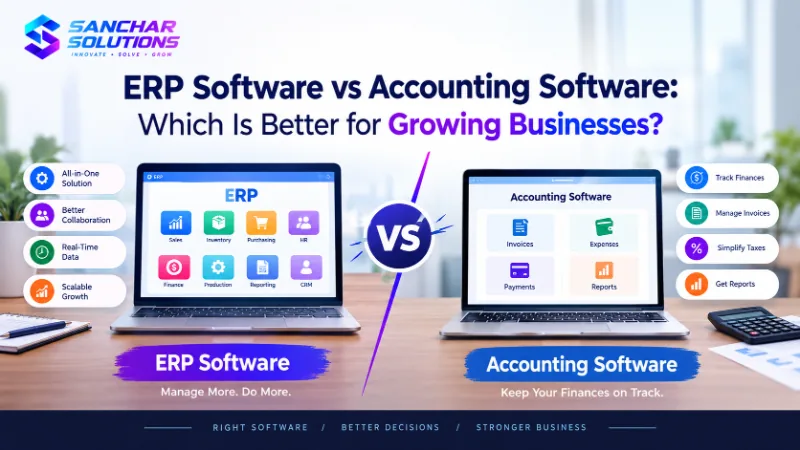
ERP Software vs Accounting Software: Which Is Better for Growing Businesses?
ERP software and accounting software serve different purposes for growing businesses. While accounting software focuses on financial…
Read article
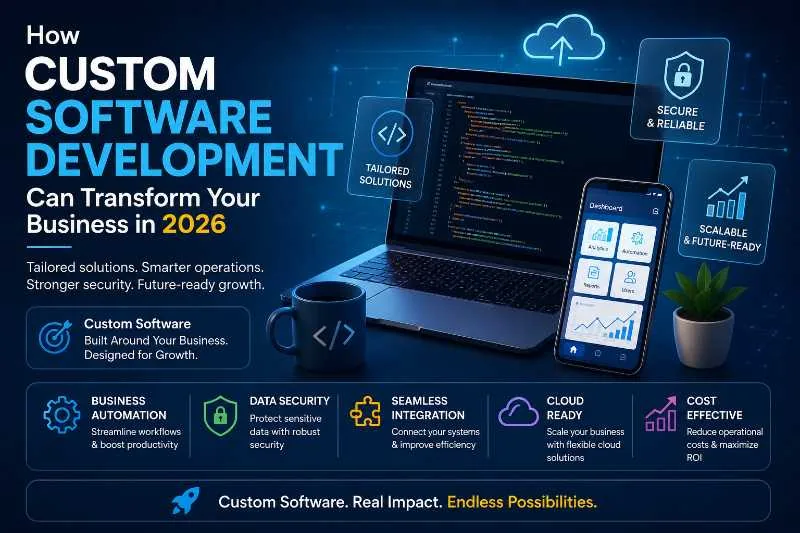
In 2026, businesses are under increasing pressure to operate faster, protect sensitive data, reduce technology costs, and provide better digital experiences to customers. Off-the-shelf software can help with basic requirements, but organizations with unique workflows often need something more flexible.
This is where custom software development becomes valuable.
Custom software is designed specifically around an organization's processes, goals, users, and technology environment. Instead of changing your business operations to fit a generic application, custom software allows the technology to fit the way your organization actually works.
For organizations that require secure data handling, reliable network infrastructure, system integration, automation, and budget-friendly technology maintenance, a well-designed custom software solution can become an important part of long-term digital transformation.
Custom software development is the process of designing, developing, testing, deploying, and maintaining software specifically for a particular business or organization.
Unlike ready-made software, custom solutions can be built around specific requirements such as:
For example, an organization may already use accounting software, CRM tools, communication platforms, and internal databases. If these systems do not communicate effectively, employees may have to enter the same information multiple times.
A custom software solution with API integration can connect these systems and create a more efficient workflow.
Technology is no longer simply an IT requirement. It directly affects productivity, customer experience, security, and operating costs.
Businesses are increasingly looking for technology that can help them:
A customized solution can address several of these challenges within one technology ecosystem.
Many organizations still depend on repetitive manual tasks such as data entry, reporting, approvals, notifications, customer follow-ups, and internal communication.
These processes consume employee time and can create avoidable errors.
Custom software can automate repetitive workflows based on your organization's requirements.
For example, software can automatically:
This allows employees to spend more time on higher-value activities instead of administrative work.
Data security has become a major concern for organizations in every industry.
Businesses manage customer information, employee records, financial information, operational data, and confidential documents. Using multiple disconnected applications can make data management more complicated.
Secure software development allows organizations to build security requirements directly into the application architecture.
Depending on the project, a custom solution can include:
The objective is not simply to create software that works, but to create software that protects business information.
For organizations handling sensitive data, security should be considered from the beginning of the development process rather than added later.
Most businesses do not operate with a single software platform.
They may use CRM systems, payment gateways, accounting platforms, communication tools, cloud services, databases, and internal applications.
When these systems operate independently, information can become fragmented.
This is where API and integration services can make a significant difference.
Custom software can be developed to connect existing platforms and create a more centralized workflow.
For example:
Customer → Website → CRM → Payment System → Notification → Internal Dashboard
Instead of employees manually transferring information between systems, integrated software can automate the movement of data.
This can improve efficiency while reducing errors.
Custom development requires an initial investment, but organizations should evaluate software based on its long-term business value, not only its development cost.
Generic software may have recurring subscription fees, unnecessary features, user limitations, or expensive upgrades.
A custom business software solution can be designed around the features an organization actually needs.
This can help reduce:
For budget-conscious organizations, the right approach is not necessarily the cheapest software. It is the technology that provides the best balance between cost, security, scalability, and business value.
Business requirements change.
A small organization may initially need only a basic internal application. As the organization grows, it may need additional users, integrations, dashboards, automation, mobile access, or cloud infrastructure.
A scalable architecture makes it easier to introduce these capabilities over time.
Custom software can be designed with future growth in mind, allowing organizations to expand functionality without replacing the entire system.
This is particularly useful for growing businesses that want to avoid repeatedly migrating from one platform to another.
Customers expect fast and convenient digital interactions.
A slow website, complicated application, disconnected support process, or delayed communication can negatively affect customer satisfaction.
Custom software can support better customer experiences through:
One of the biggest technology opportunities in 2026 is the combination of custom software and AI.
Organizations can integrate AI capabilities into existing applications instead of creating completely separate AI tools.
Examples include:
For example, a custom CRM could use AI to analyze customer interactions and automatically identify high-priority leads.
This is where AI integration and business automation can add significant value to custom software.
Software performance also depends on the infrastructure supporting it.
Organizations that require reliable network setup, secure cloud environments, cybersecurity, DevOps, and ongoing maintenance need to consider software and infrastructure together.
A complete technology strategy may include:
Custom Software + Cloud Solutions + Cybersecurity + DevOps + Managed IT Services
This approach can help organizations maintain reliable systems while preparing their technology environment for future growth.
Cloud infrastructure can also provide flexibility by allowing organizations to scale computing resources according to demand.
Selecting the right development partner is an important decision.
Before starting a project, organizations should evaluate:
Does the provider have experience with web, mobile, cloud, APIs, databases, and modern software architecture?
Does the development process include authentication, access controls, secure APIs, testing, and data protection?
Can the provider connect your existing CRM, ERP, communication, payment, or cloud platforms?
Can the software support increasing users, data, and business requirements?
Does the provider offer ongoing updates, monitoring, bug fixing, and technical support?
A good technology partner should understand the business problem—not just the programming requirements.
In 2026, custom software development is becoming more than a way to build applications. It can serve as the technology foundation for automation, secure data management, system integration, customer experience, and business growth.
For organizations that need secure data handling, reliable IT infrastructure, network solutions, and cost-effective technology maintenance, a customized approach can provide greater flexibility than relying entirely on generic software.
The right solution does not have to replace every system your organization currently uses. In many cases, the better strategy is to integrate existing technologies, automate inefficient processes, strengthen security, and develop only the functionality your business actually needs.
Whether you need a custom web application, mobile app, API integration, business automation platform, cloud solution, or ongoing IT support, the goal should always be the same: use technology to make your business more secure, efficient, scalable, and competitive.
For organizations planning their next digital transformation project, 2026 can be the right time to evaluate where custom software can deliver measurable business value.
Custom software development is the process of creating software specifically for an organization's unique business requirements. It can include web applications, mobile apps, enterprise software, automation systems, APIs, dashboards, and integrated business platforms.
It depends on the organization's requirements. Off-the-shelf software can be suitable for standard business processes, while custom software is more appropriate when a business needs unique workflows, specialized features, integrations, greater control, or specific security requirements.
Custom software can incorporate security features such as role-based access, authentication, encryption, secure APIs, audit logs, monitoring, and controlled data access. Security requirements can be considered throughout the development lifecycle.
Custom software can be suitable for small and growing businesses when the project is properly scoped. Businesses can begin with essential features and expand the system as their requirements and budgets grow, rather than investing in unnecessary functionality.
Yes. Custom software can use APIs and integration technologies to connect CRM platforms, payment systems, databases, communication tools, cloud services, and other business applications. This can reduce manual data entry and create more efficient workflows.
Our team of developers, SEO specialists and marketers has delivered 350+ projects for clients in 10+ countries. We write about what we practise every day.
Engineering custom software solutions that streamline your operations, automate tasks, and solve your unique business challenges.
Explore Software Development ServicesERP software and accounting software serve different purposes for growing businesses. While accounting software focuses on financial…
Read articleSEO vs. Google Ads in 2026: Discover the key differences, costs, benefits, and results of both strategies. Learn which digital marketing…
Read articleKeep your business website secure, fast, and up to date with professional website maintenance services from Sanchar Solutions. Discover…
Read articleShare your requirements and get a free consultation, timeline and fixed-price quote within 24 hours.