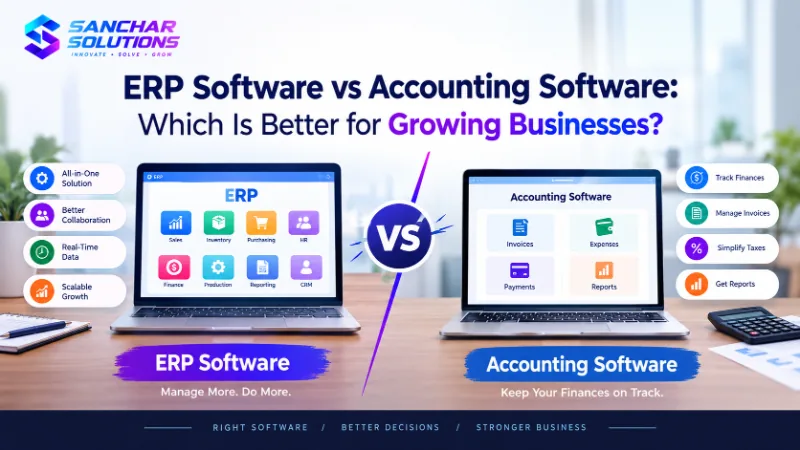
ERP Software vs Accounting Software: Which Is Better for Growing Businesses?
ERP software and accounting software serve different purposes for growing businesses. While accounting software focuses on financial…
Read article
E-commerce has transformed the way businesses sell products and customers make purchasing decisions. Today, customers expect more than simply being able to view products and place an order. They want a fast, secure, convenient, personalized, and seamless shopping experience across smartphones, tablets, and desktop devices.
For businesses planning to launch an online store or upgrade an existing one, choosing the right e-commerce development strategy is essential. A modern online store needs to combine attractive design with powerful functionality, strong security, easy navigation, flexible payment options, and reliable performance.
Whether you are a small business launching your first online store or an established company looking to expand its digital sales, understanding the essential features of modern e-commerce development can help you build a website that attracts customers and converts visitors into buyers.
In this article, we will explore the key features every modern online store should have and explain why they matter for long-term e-commerce success.
E-commerce development refers to the process of designing, building, customizing, and maintaining an online store where customers can browse products or services and complete transactions digitally.
E-commerce development can include:
A successful e-commerce website is not simply an online product catalog. It is a complete digital sales platform designed to guide customers from product discovery to purchase and, ideally, repeat business.
Customers have countless options when shopping online. If your website is difficult to navigate, slow to load, confusing, or unreliable, customers can easily leave and purchase from a competitor.
The right e-commerce features can help your business:
Your online store should therefore be designed around both customer expectations and business objectives.
Mobile shopping is a major part of modern e-commerce. Customers may discover a product through a smartphone search, social media post, advertisement, or email and immediately visit your website.
Your online store needs to provide a smooth experience on:
A responsive design automatically adapts the layout and content to different screen sizes.
Important mobile-friendly features include:
A mobile-friendly website is no longer an optional feature. It should be a fundamental part of your e-commerce development strategy.
Customers should be able to find what they are looking for quickly.
Complicated navigation can frustrate visitors and cause them to leave your website.
A modern online store should organize products into logical categories and subcategories.
For example:
Men → Clothing → Shirts → Casual Shirts
or:
Electronics → Smartphones → Android Phones
Your navigation should also include useful elements such as:
The easier it is for customers to discover products, the more likely they are to continue shopping.
Product search is particularly important for stores with large catalogs.
Customers often know exactly what they want and prefer searching rather than browsing multiple categories.
A powerful search system should support:
Advanced e-commerce websites can also provide autocomplete suggestions as customers type.
For example, when a customer types "wireless," the search system might suggest:
This can make product discovery faster and improve the shopping experience.
Product pages are one of the most important parts of an online store.
Customers cannot physically touch or inspect products online, so your product pages need to provide enough information to help them make confident purchasing decisions.
A strong product page should include:
Product descriptions should focus not only on features but also on benefits.
Instead of simply saying that a product has a particular feature, explain how that feature benefits the customer.
Visual content plays a major role in online purchasing decisions.
Customers want to see what they are buying before placing an order.
Consider providing:
Images should be high quality while still being properly optimized for fast loading.
Large, unoptimized images can significantly slow down an online store.
The shopping cart allows customers to review products before moving to checkout.
A good shopping cart should make it easy to:
Customers should be able to move between the cart and product pages without losing their selections.
A persistent cart can also help customers return to products they previously added.
Checkout is one of the most important stages in the customer journey.
A complicated checkout process can cause customers to abandon their carts.
A modern checkout should be:
Avoid asking customers for unnecessary information.
Useful checkout features can include:
Reducing unnecessary steps can make the checkout experience much more efficient.
Customers have different payment preferences.
Depending on your target market, an online store may need to support options such as:
Providing multiple trusted payment options can make customers more comfortable completing their purchases.
Payment systems should also be securely integrated and properly tested.
Security is critical for e-commerce websites because online stores may process customer information, account details, addresses, and payments.
Important security measures include:
Customers need to feel confident that their personal and payment information is being handled securely.
Security should therefore be considered from the beginning of the e-commerce development process rather than added later.
Customer accounts can provide a more personalized shopping experience.
Customers may be able to:
However, account creation should not be forced unnecessarily.
Providing guest checkout alongside optional accounts can give customers more flexibility.
Customer reviews can significantly influence purchasing decisions.
People often want to know what other customers think before buying a product.
An effective review system can allow customers to:
Authentic reviews can help build trust and provide useful information to potential customers.
Businesses should have appropriate moderation processes to prevent spam and abusive content.
Not every visitor is ready to purchase immediately.
A wishlist allows customers to save products for later.
This feature can be particularly useful for:
Wishlists can encourage customers to return to the website and eventually complete a purchase.
They can also provide useful behavioral insights for businesses.
Modern e-commerce stores can use customer behavior and product data to provide relevant recommendations.
Examples include:
You May Also Like
Customers Also Bought
Recommended for You
Recently Viewed Products
Personalization can help customers discover relevant products while potentially increasing average order value.
Recommendations should be relevant rather than overwhelming. Poorly targeted suggestions can make the shopping experience less useful.
Promotional features can help businesses attract customers and increase sales.
Your e-commerce platform may need to support:
The promotion system should include clear rules so discounts are applied correctly and profit margins can be controlled.
Inventory management becomes increasingly important as your business grows.
An e-commerce system should ideally provide accurate information about:
Automated inventory management can reduce errors and help prevent customers from purchasing products that are unavailable.
For businesses with physical stores as well as online operations, integration between online and offline inventory can be especially valuable.
After customers place an order, they want to know what happens next.
A modern e-commerce platform should support:
Customers should be able to access order information easily through their account or confirmation emails.
Good post-purchase communication can improve customer satisfaction and encourage repeat purchases.
Shipping is an important part of the online shopping experience.
Depending on your business model, your website may need to support:
Customers should know the expected delivery cost and timeframe before completing their purchase.
Unexpected shipping costs are a common reason customers abandon their carts.
Search engines can be an important source of traffic for online stores.
Your e-commerce website should provide a strong technical foundation for SEO.
Important elements include:
Each product and category page should also provide useful, unique content rather than relying entirely on generic manufacturer descriptions.
You cannot effectively improve your online store if you do not understand how customers use it.
Analytics can provide information about:
This information can help you identify problems and make data-driven decisions.
For example, if many users visit a product page but very few add the product to their cart, you may need to improve the product description, images, pricing, reviews, or call to action.
Customers sometimes need assistance before or after making a purchase.
Your online store can provide support through:
Fast and helpful customer support can improve customer satisfaction and reduce uncertainty during the purchasing process.
Social media can help businesses promote products and reach new customers.
Your website can integrate with social platforms by providing:
Social media integration should support your marketing strategy without making the website unnecessarily complicated.
Your e-commerce website should be designed with future growth in mind.
As your business grows, you may need:
A scalable architecture makes it easier to add these capabilities without completely rebuilding your online store.
Performance directly affects the shopping experience.
An online store should load quickly and remain responsive even during periods of high traffic.
Performance optimization may include:
Performance should be monitored continuously rather than only when the website is launched.
If you sell internationally, customers may expect to browse your website in their preferred language and see prices in their local currency.
Depending on your business, you may need:
These features can make it easier to expand into new markets.
Your marketing team should be able to update products, content, banners, promotions, and other website information without depending on developers for every small change.
A good content management system can help your team:
Easy content management can save time and reduce operational costs.
There is no single e-commerce technology that is perfect for every business.
Your choice should depend on:
Some businesses may benefit from established e-commerce platforms, while others may require custom development.
The goal is not to select the most complicated solution. The goal is to choose a solution that meets your requirements today and can support your business tomorrow.
Even a feature-rich online store can fail if important fundamentals are overlooked.
Common mistakes include:
A website that works well only on desktops can lose a significant number of potential customers.
Too many fields and unnecessary steps can increase cart abandonment.
Customers need clear visuals to make informed decisions.
Security issues can damage both customer trust and your business reputation.
Slow pages can negatively affect user experience and conversions.
A website that works for a small business may struggle when traffic and product volume increase.
Without analytics, it is difficult to understand what is working and what needs improvement.
Modern e-commerce development requires much more than creating a website with product pages and a shopping cart. Successful online stores combine user-friendly design, powerful functionality, strong security, fast performance, effective SEO, and a seamless purchasing experience.
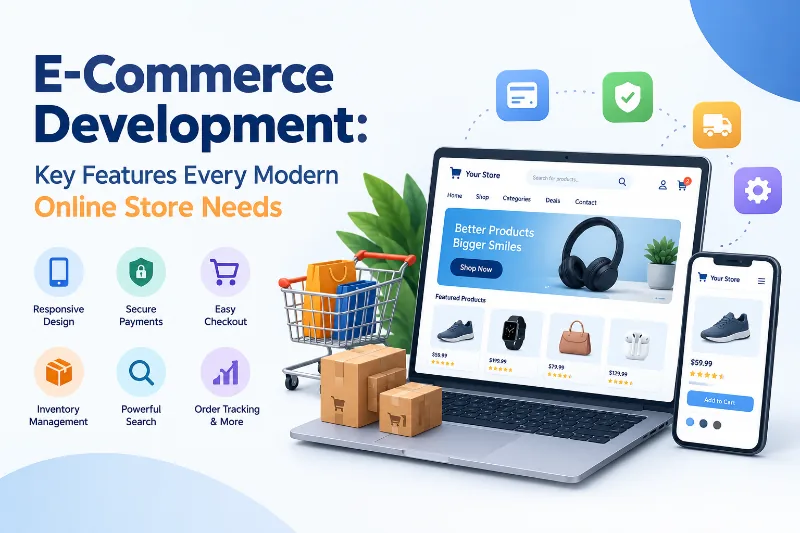
Features such as responsive design, product search, detailed product pages, secure payments, simple checkout, customer reviews, inventory management, order tracking, analytics, and personalization can make a significant difference to the success of an online store.
However, you should not add features simply because they are popular. Every feature should have a clear purpose and contribute to either customer experience, business efficiency, sales, or long-term growth.
Whether you are launching a new online store or improving an existing one, investing in the right e-commerce development strategy can help you create a reliable digital sales channel and build stronger relationships with your customers.
The best online store is not necessarily the one with the most features. It is the one that makes it easy for customers to find what they need, trust your business, complete their purchase, and come back again.
E-commerce development is the process of designing, developing, customizing, and maintaining an online store. It includes features such as product catalogs, shopping carts, payment gateways, customer accounts, order management, inventory, shipping, security, and integrations.
Some of the most important features include responsive design, easy navigation, product search, detailed product pages, shopping cart functionality, simple checkout, secure payments, customer reviews, inventory management, order tracking, analytics, SEO, and customer support.
Many customers browse and shop using mobile devices. A responsive website ensures that your online store works properly across smartphones, tablets, and desktops, providing customers with a consistent and convenient shopping experience.
You can reduce cart abandonment by simplifying the checkout process, offering multiple payment methods, displaying shipping costs clearly, providing guest checkout, improving website speed, building trust with security information and reviews, and avoiding unexpected charges.
Yes. Product search is particularly important for stores with large catalogs. A powerful search feature helps customers quickly find relevant products and can improve the overall shopping experience.
The right payment methods depend on your target customers and market. Common options include debit and credit cards, digital wallets, bank transfers, local payment methods, and other regionally appropriate payment solutions.
Security is extremely important because online stores may handle customer information and payment transactions. Businesses should use secure connections, reliable payment processing, strong access controls, regular updates, backups, and appropriate security monitoring.
Yes. Reviews and ratings can help customers make purchasing decisions and increase trust. Authentic customer feedback can provide useful information that product descriptions alone may not communicate.
SEO can help your products and category pages appear in search engine results and attract potential customers without relying entirely on paid advertising. Technical SEO, product content, page speed, structured data, internal linking, and mobile optimization can all contribute to better search visibility.
Slow websites can frustrate customers and cause them to leave before purchasing. Fast page loading improves the shopping experience and can support better engagement and conversion performance.
Inventory management is particularly important for businesses selling physical products. It helps track stock levels, prevent overselling, identify low-stock products, and keep product availability accurate.
A scalable e-commerce website is designed so that it can handle increasing numbers of products, customers, transactions, and website visitors as the business grows. Scalability also makes it easier to introduce new features and integrations in the future.
For many businesses, yes. Guest checkout allows customers to complete purchases without creating an account. You can still offer optional accounts for customers who want order history, saved addresses, wishlists, or other benefits.
Relevant product recommendations can help customers discover complementary or related products. Features such as "Customers Also Bought" or "You May Also Like" can potentially increase the number of products customers purchase during a session.
The cost varies considerably depending on the number of products, design requirements, functionality, integrations, customization, security requirements, and development approach. A simple online store may require a much smaller investment than a large custom e-commerce platform.
The right choice depends on your requirements. An existing platform can provide faster development and many built-in features, while custom development can provide greater control and specialized functionality. Your business goals, budget, and future plans should guide the decision.
Before development begins, define your target audience, products, business model, payment methods, shipping strategy, required integrations, budget, expected traffic, security requirements, SEO strategy, and future growth plans.
Building a modern online store is an investment in your business's digital future. By focusing on the features that matter most to customers—speed, convenience, security, trust, simple navigation, and an effortless checkout experience—you can create an e-commerce website that is designed not only to attract visitors but also to turn them into loyal customers.
The right combination of technology, design, functionality, and strategy can give your online store a strong foundation for sustainable growth.
Our team of developers, SEO specialists and marketers has delivered 350+ projects for clients in 10+ countries. We write about what we practise every day.
We design high-performance online stores with seamless integrations, secure payments, and conversion-focused user experiences.
Explore Ecommerce Web DevelopmentERP software and accounting software serve different purposes for growing businesses. While accounting software focuses on financial…
Read articleSEO vs. Google Ads in 2026: Discover the key differences, costs, benefits, and results of both strategies. Learn which digital marketing…
Read articleKeep your business website secure, fast, and up to date with professional website maintenance services from Sanchar Solutions. Discover…
Read articleShare your requirements and get a free consultation, timeline and fixed-price quote within 24 hours.