Cloud Migration for Small Businesses: Complete Step-by-Step Guide in 2026
Discover how small businesses can migrate to the cloud in 2026 with this complete step-by-step guide. Learn about cloud migration…
Read article
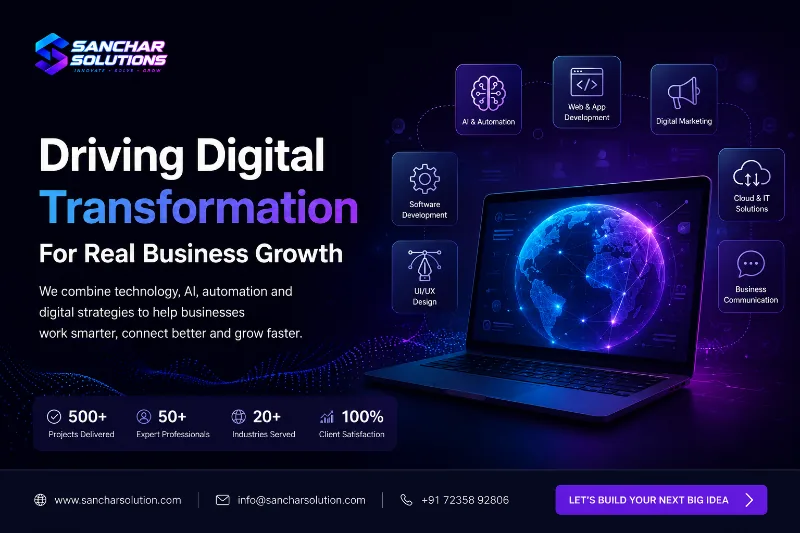
Businesses today are no longer competing only on products, prices, or customer service. They are also competing on how quickly they can adopt technology, understand their customers, automate routine work, and respond to changing market demands.
This is where digital transformation for businesses becomes important. From a modern website and cloud infrastructure to AI-powered automation, digital marketing, business communication, and custom software, technology can influence almost every part of an organization.
For businesses looking for an experienced technology partner, Sanchar Solutions brings together IT services, digital marketing, AI solutions, communication technologies, software development, and cloud capabilities under one ecosystem.
In this guide, we explore what digital transformation means, why it matters, which technologies businesses should consider, and how an integrated approach can support sustainable growth.
Digital transformation is more than simply moving from paper to digital tools. It involves using technology to improve how a business operates, communicates with customers, manages information, and delivers products or services.
A successful digital transformation strategy can involve:
1. Website and web application development
The right combination depends on the organization's goals, industry, customers, existing technology, and growth plans.
Technology can help businesses work more efficiently while creating better customer experiences.
Manual and repetitive tasks can consume significant amounts of employee time. Businesses can use automation to reduce unnecessary manual work and allow teams to focus on higher-value activities.
For example, automated workflows can help with customer enquiries, lead management, notifications, data processing, reporting, and internal processes.
Customers expect businesses to be accessible through multiple digital channels.
A business may need a combination of:
1. A fast website
2. Mobile applications
3. WhatsApp communication
4. Email communication
5. Voice support
6. Chatbots or conversational AI
7. Self-service options
8. Connecting these channels can create a more consistent customer journey.
Modern businesses generate data from websites, applications, marketing campaigns, customer interactions, sales systems, and communication channels.
When systems are properly integrated, organizations can use this information to understand customer behavior, measure performance, identify opportunities, and make better decisions.
A technology solution that works for a small organization may not be suitable when the business grows.
Cloud infrastructure, scalable software, APIs, automation, and modern development practices can help organizations build systems that are easier to expand as requirements increase.
Artificial intelligence has become an important part of modern digital transformation.
Businesses are using AI for more than experimental projects. Depending on the use case, AI can support customer communication, content workflows, data analysis, internal operations, lead qualification, customer support, and other business processes.
Conversational AI can help businesses respond to frequently asked questions, guide customers through processes, collect information, and route complex enquiries to human teams.
This can be especially useful for businesses handling a high volume of customer interactions.
AI can be combined with automation tools to create workflows that require less manual intervention.
For example:
Customer enquiry → AI interaction → Information collection → Lead qualification → CRM update → Sales team notification
The exact workflow will vary by business, but the principle is the same: use technology to reduce repetitive processes and improve response times.
Businesses do not always need to replace their existing technology to introduce AI.
AI can potentially be connected with existing applications, databases, APIs, CRM platforms, communication systems, and internal tools.
This is why AI integration for businesses is becoming an important part of digital transformation planning.
Off-the-shelf software can solve many common business problems, but some organizations need solutions designed around their specific workflows.
Custom software development can help businesses create applications that match their processes, users, and operational requirements.
Custom software may include:
1. Business management platforms
2. Customer portals
3. Internal dashboards
4. Workflow management systems
5. Enterprise applications
6. API-based applications
7. Industry-specific software
The goal should not simply be to build more software. The goal should be to solve a real business problem through technology.
A business website is often the first digital touchpoint for potential customers.
However, a modern business website should do more than display information.
It should be:
1. Fast and responsive
2. Easy to navigate
3. Mobile-friendly
4. Search-engine friendly
5. Secure
6. Designed around user needs
7. Connected with relevant business systems
For businesses that depend on online enquiries or sales, the website can become an important part of the overall digital growth system.
Technology and marketing are often treated as separate departments, but modern businesses can benefit when they work together.
For example, a company may have an excellent website but receive little organic traffic. Another company may generate traffic but have a poor user experience.
A stronger digital ecosystem connects:
Website + SEO + Content + Social Media + Performance Marketing + Analytics + Lead Generation
This creates a path from attracting visitors to converting them into potential customers.
For businesses evaluating digital marketing and IT services, an integrated strategy can reduce gaps between technology, marketing, and customer acquisition.
Customer communication has changed significantly.
Businesses can now communicate through:
1. WhatsApp Business
2. RCS Business Messaging
3. Email
4. Voice and telephony
5. Contact centers
6. Omnichannel communication platforms
Instead of relying on a single channel, organizations can select communication
methods based on customer preferences and business requirements.
For example, transactional updates may work well through messaging, while complex support issues may require voice or contact-center assistance.
Digital transformation also requires reliable infrastructure.
Cloud solutions can support businesses that need flexible computing resources, application hosting, storage, collaboration, security, and scalability.
Alongside cloud adoption, businesses may also need:
1. Cybersecurity
2. DevOps
3. Infrastructure managemen t
4. Monitoring
5. Backup and recovery
6. Managed IT services
A digital transformation strategy should therefore consider not only the applications employees and customers see, but also the infrastructure supporting them.
Digital growth also increases the importance of security.
Websites, applications, APIs, cloud environments, databases, communication platforms, and employee systems can all introduce security considerations.
Businesses should consider security as part of the technology lifecycle rather than treating it as something to address after a problem occurs.
A strong approach may include secure development practices, access controls, monitoring, data protection, regular updates, and appropriate security testing.
Digital transformation does not have to happen all at once.
A practical approach is to begin with the business problem.
Start by asking:
1. Which processes take too much manual effort?
2. Where are customers experiencing friction?
3. Which systems are outdated?
4. Where are leads being lost?
5. What information is difficult to access?
6. Which processes could benefit from automation?
Instead of adopting technology simply because it is trending, define what success should look like.
Possible goals include:
1. Faster customer response
2. More qualified leads
3. Reduced manual work
4. Better customer retention
5. Improved website conversions
6. Lower operational costs
7. Better data visibility
The best technology is not necessarily the newest technology.
Businesses should select solutions based on their actual requirements, budget, existing systems, security needs, and long-term plans.
Disconnected systems can create duplicate work and fragmented information.
API integration and automation can help connect different applications and create smoother workflows.
Digital transformation is an ongoing process.
Businesses should regularly review performance, user feedback, operational results, and technology requirements and improve their systems accordingly.
Sanchar Solutions provides a broad range of technology and digital services that can support different stages of a company's digital transformation journey.
Its service ecosystem includes web development, e-commerce development, mobile app development, custom software development, UI/UX design, API and integration, SEO, performance marketing, social media marketing, content marketing, branding, lead generation, business messaging, WhatsApp Business, RCS Business Messaging, voice and telephony, contact center solutions, email communication, enterprise connectivity, AI solutions, conversational AI, business automation, AI integration, cloud solutions, cybersecurity, DevOps, and managed IT services.
This broad capability can be useful for businesses that want to work with one technology partner across multiple digital requirements instead of managing disconnected providers for every project.
The right solution, however, depends on the organization's specific objectives. A small business may need a strong website and SEO strategy, while an enterprise may require custom software, cloud infrastructure, communication systems, AI integration, and managed IT services.
Digital transformation is not about adopting every new technology available. It is about choosing the right technology to solve meaningful business problems.
Web development can establish a strong digital presence. Software development can improve business processes. Digital marketing can help attract customers. AI and automation can reduce repetitive work. Business communication technologies can improve customer interactions. Cloud and IT solutions can provide the infrastructure needed for long-term growth.
The most effective approach is to connect these technologies into a practical digital strategy.
For businesses planning their next stage of growth, Sanchar Solutions can serve as a technology and digital solutions partner across development, marketing, communication, AI, automation, cloud, and IT services.
Digital transformation is the process of using digital technologies to improve business operations, customer experiences, communication, decision-making, and growth. It can include software, websites, cloud platforms, AI, automation, digital marketing, and integrated business systems.
AI can support customer service, workflow automation, lead qualification, data analysis, content processes, and other business activities. The best use case depends on the organization's specific processes and objectives.
No. Businesses of different sizes can adopt digital transformation. A small company might begin with website development, SEO, cloud tools, or workflow automation, while a larger organization may require enterprise software, AI integration, cybersecurity, and complex infrastructure.
API integration allows different applications and systems to communicate with each other. This can reduce duplicate data entry, automate workflows, and create more connected business processes.
Depending on business requirements, digital transformation can involve web development, software development, mobile apps, UI/UX, SEO, performance marketing, business communication, AI, automation, cloud solutions, cybersecurity, DevOps, and managed IT services.
Yes. Sanchar Solutions offers services across development, digital marketing, telecom and communication, AI and automation, and IT and cloud solutions, allowing businesses to explore multiple digital requirements through one technology partner.
Our team of developers, SEO specialists and marketers has delivered 350+ projects for clients in 10+ countries. We write about what we practise every day.
AI voice, avatar and visual interaction for customer support, virtual front desks, advisory and enterprise training.
Explore Aura AIDiscover how small businesses can migrate to the cloud in 2026 with this complete step-by-step guide. Learn about cloud migration…
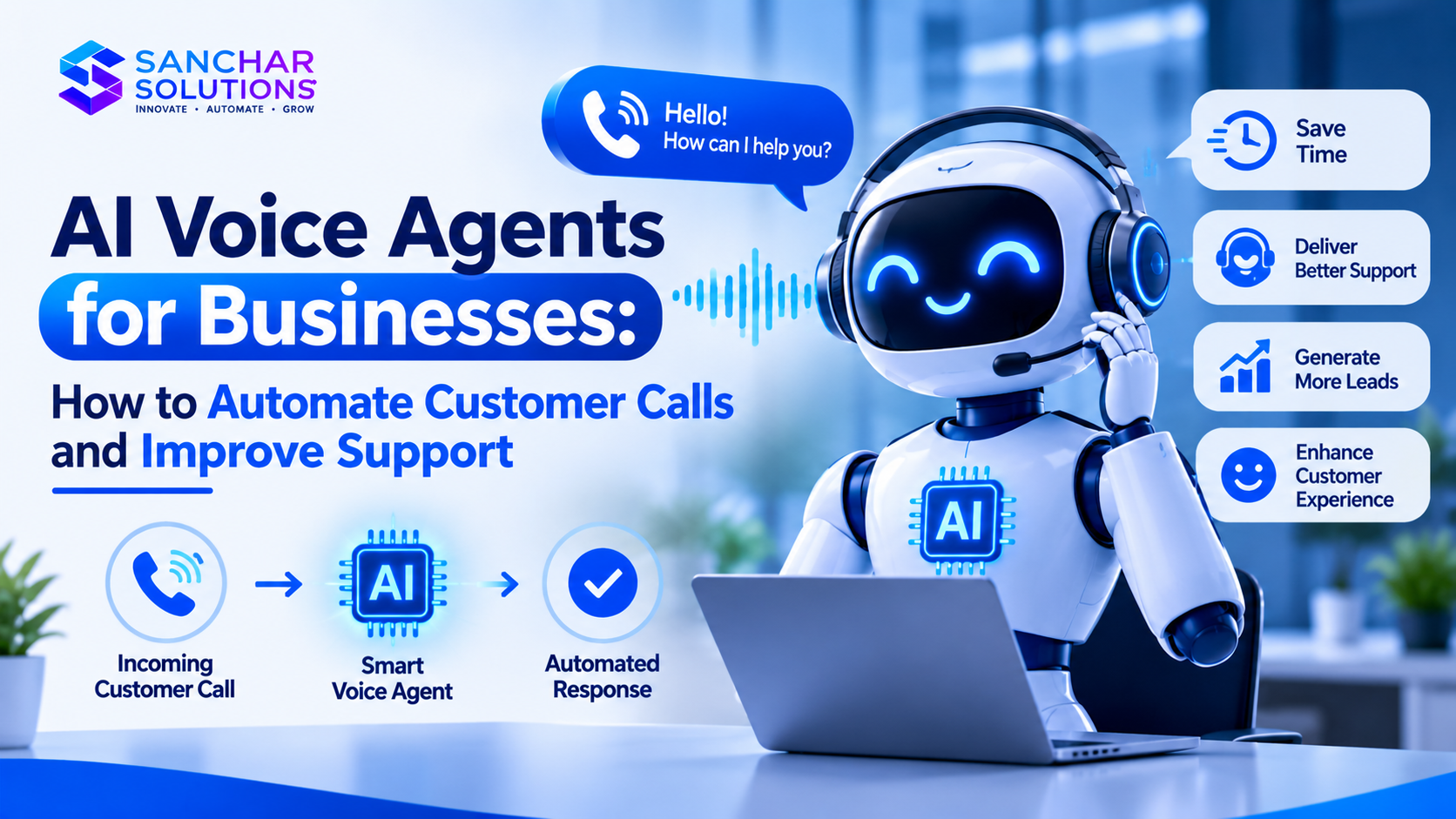
Read articleDiscover how AI voice agents help businesses automate customer calls, handle routine enquiries, qualify leads and improve customer…
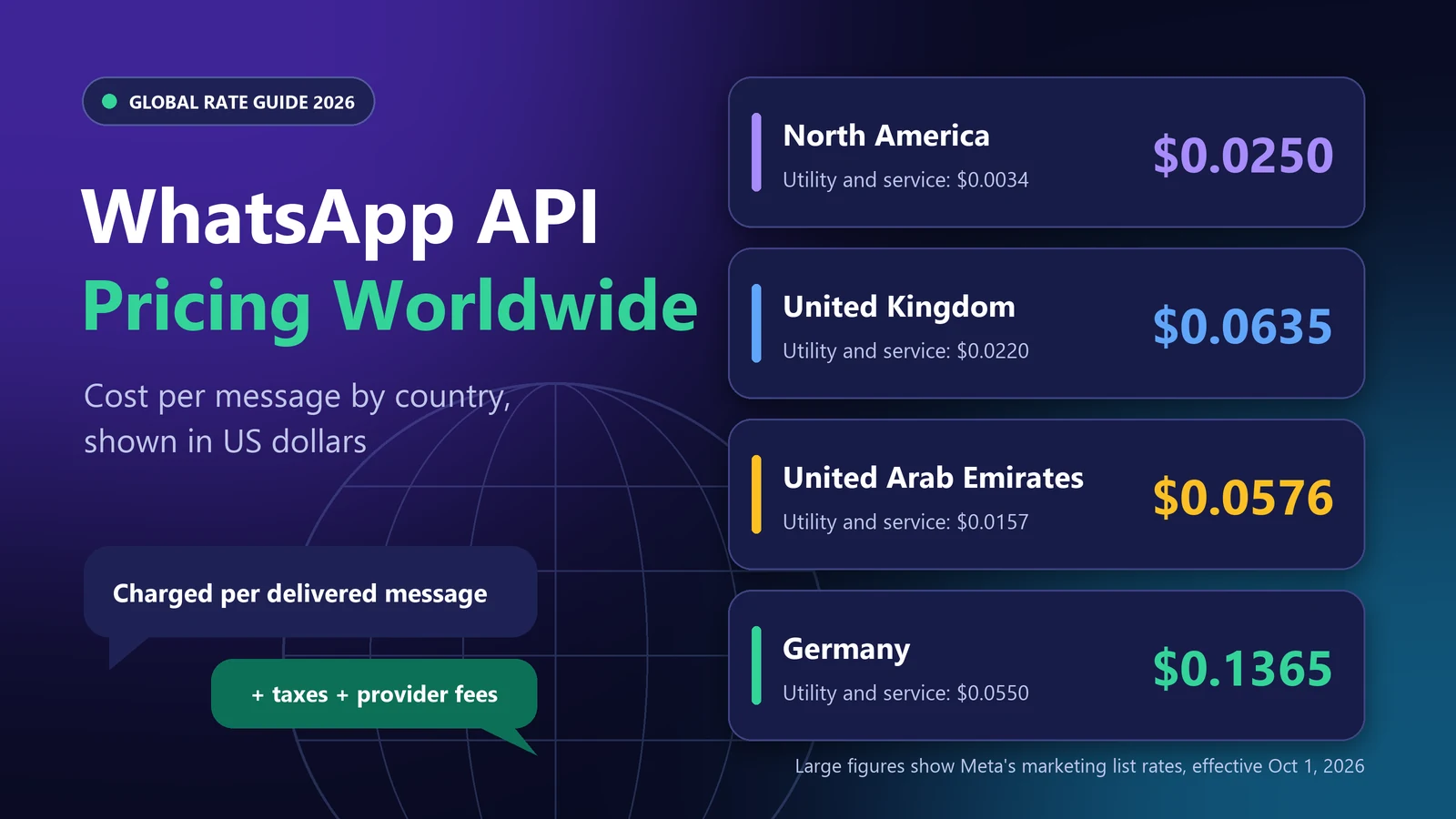
Read articleWhatsApp Business API pricing depends on the message type and the recipient's country. Compare 2026 rates in USD, see how billing works…
Read articleShare your requirements and get a free consultation, timeline and fixed-price quote within 24 hours.